
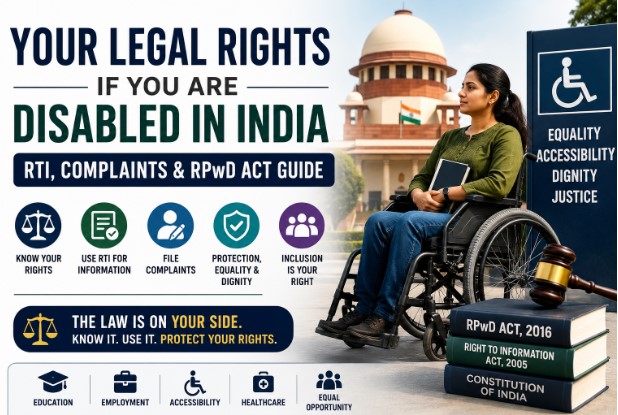
If you are a person with a disability in India, the law provides far more protection than many people realise.
The Rights of Persons with Disabilities Act, 2016 (RPwD Act) is one of India’s most important disability rights laws. It guarantees legal rights related to education, employment, accessibility, healthcare, equality, and protection against discrimination. These rights are supported by enforcement mechanisms, grievance redressal systems, and the Right to Information (RTI) Act, 2005.
Yet many persons with disabilities and their families are still unaware of the protections available to them. As a result, violations often go unchallenged simply because people do not know where to complain or how to assert their rights.
This guide explains the RPwD Act in simple terms and outlines how persons with disabilities can:
- understand their legal rights,
- file complaints,
- use RTI applications effectively,
- and seek accountability when rights are violated.
Understanding the RPwD Act 2016
The Shift from Welfare to Rights
Before 2016, disability laws in India largely followed a welfare-based approach. The RPwD Act changed that framework significantly by recognising disability rights as legal and enforceable rights rather than acts of charity or social support.
The Act is based on the United Nations Convention on the Rights of Persons with Disabilities (UNCRPD), which India ratified in 2007. It recognises that disability is often created not only by impairments, but also by social, physical, and institutional barriers.
Who Is Covered Under the Act?
The RPwD Act expanded the number of recognised disabilities from 7 categories to 21 categories.
These include:
- Blindness
- Low vision
- Hearing impairment
- Locomotor disability
- Intellectual disability
- Autism spectrum disorder
- Cerebral palsy
- Mental illness
- Muscular dystrophy
- Multiple sclerosis
- Specific learning disabilities
- Speech and language disability
- Parkinson’s disease
- Acid attack victims
- Multiple disabilities including deaf-blindness
The Central Government also has the authority to notify additional disability categories when required.
Disability Certificate and UDID Card
To access many benefits under the RPwD Act, individuals generally need a Disability Certificate issued by a recognised medical authority.
The certificate specifies:
- type of disability,
- percentage of disability,
- and eligibility for benchmark disability benefits.
In many cases, benefits apply to persons with benchmark disabilities of 40% or more.
The Unique Disability ID (UDID) card system was introduced to create a nationally recognised and portable disability identification system.
Key Rights Under the RPwD Act
Right to Equality and Non-Discrimination
The RPwD Act prohibits discrimination against persons with disabilities in areas such as:
- education,
- employment,
- healthcare,
- public services,
- and access to public spaces.
Discrimination may include:
- denial of opportunities,
- refusal of reasonable accommodation,
- exclusion from participation,
- or unequal treatment based on disability.
Right to Reasonable Accommodation
Reasonable accommodation refers to necessary modifications that allow persons with disabilities to participate equally in workplaces, educational institutions, and public services.
Examples include:
- accessible workstations,
- flexible schedules,
- assistive technologies,
- modified teaching methods,
- or accessible communication systems.
Failure to provide reasonable accommodation without valid justification may amount to a violation of the Act.
Right to Accessibility
The RPwD Act requires public infrastructure and services to become progressively accessible.
This includes:
- ramps and lifts,
- accessible toilets,
- tactile pathways,
- accessible transport systems,
- accessible websites,
- and information in formats such as Braille or audio.
Accessibility obligations apply to many government buildings, transport systems, and public services.
Right to Education
Children with disabilities have the right to inclusive education without discrimination.
The law provides protections related to:
- admission in schools,
- support services,
- assistive devices,
- trained teachers,
- and educational accommodations.
Children with benchmark disabilities are also entitled to free education up to a specified age under applicable provisions.
Right to Employment
Government establishments are required to reserve a percentage of vacancies for persons with benchmark disabilities.
The Act also provides protections related to:
- equal opportunity,
- non-discrimination in employment,
- and grievance redressal mechanisms for employees with disabilities.
Many organisations are also expected to create equal opportunity policies and accessible workplaces.
How the RTI Act Can Help Persons with Disabilities
The Right to Information Act, 2005 allows Indian citizens to request information from public authorities.
For persons with disabilities, RTI can be a powerful tool for accountability.
Examples of Useful RTI Applications
RTI applications can be used to seek information about:
Disability Reservation in Government Jobs
Questions may include:
- number of reserved vacancies,
- number of positions filled,
- recruitment policies,
- and backlog vacancies.
Accessibility Compliance
Citizens can request:
- accessibility audit reports,
- timelines for accessibility improvements,
- and infrastructure compliance details.
Welfare Scheme Implementation
RTIs may help track:
- pending applications,
- fund allocation,
- scholarship disbursement,
- and implementation status of disability welfare schemes.
UDID Delays
Applicants can request updates regarding:
- processing delays,
- pending approvals,
- and application timelines.
How to File an RTI Application
Step 1: Identify the Correct Public Authority
The application should be addressed to the Public Information Officer (PIO) of the relevant government department.
Step 2: Draft Clear Questions
Applications should:
- ask specific questions,
- avoid vague requests,
- and clearly mention that the request is filed under the RTI Act, 2005.
Step 3: Pay the Application Fee
Most RTI applications require a nominal fee unless exemptions apply.
Step 4: Submit the Application
Applications may be submitted:
- online,
- by post,
- or in person depending on the department.
Step 5: Wait for the Response
Public authorities are generally required to respond within 30 days.
If no response is received or the reply is unsatisfactory, applicants can file appeals under the RTI process.
Filing Complaints Under the RPwD Act
State Commissioner for Persons with Disabilities
Every state appoints a State Commissioner responsible for:
- investigating complaints,
- monitoring implementation,
- and addressing disability rights violations.
Complaints may involve:
- inaccessible infrastructure,
- discrimination,
- denial of services,
- or failure to provide accommodations.
Chief Commissioner for Persons with Disabilities
The Chief Commissioner handles matters involving:
- central government establishments,
- national-level issues,
- and multi-state concerns.
Other Legal Forums
Depending on the issue, complaints may also be filed before:
- Human Rights Commissions,
- Consumer Courts,
- Labour Courts,
- or other legal authorities.
Different forums may apply depending on whether the issue involves employment, healthcare, education, accessibility, or service denial.
Common Disability Rights Violations and Responses
Employment Discrimination
If an employer refuses opportunities solely because of disability:
- request written communication if possible,
- document the incident,
- and approach the relevant grievance authority or commissioner.
Denial of School Admission
Schools denying admission to children with disabilities may be violating inclusive education obligations under the RPwD Act.
Inaccessible Public Infrastructure
Government buildings lacking basic accessibility features may violate accessibility provisions under the law.
Documenting barriers through photographs and written complaints can strengthen the grievance process.
Delayed Disability Documentation
Long delays in Disability Certificate or UDID processing can be challenged through RTI applications and formal grievances.
Where Persons with Disabilities Can Seek Support
Support may be available through:
- State Legal Services Authorities,
- District Legal Services Authorities,
- disability rights groups,
- advocacy organisations,
- and government welfare bodies.
Persons with disabilities may also be eligible for free legal aid under applicable legal aid provisions.
Final Thoughts
The RPwD Act 2016 is not merely a policy document — it is enforceable law.
The protections related to equality, accessibility, education, employment, and dignity are legal rights available to persons with disabilities across India.
While challenges in implementation still exist, awareness remains one of the most powerful tools for change.
Understanding your rights, filing RTI applications, documenting violations, and using available grievance mechanisms are legitimate and important steps toward accountability and inclusion.
About the Author
Disability Activists is a platform focused on disability rights awareness, accessibility advocacy, and legal guidance related to the Rights of Persons with Disabilities (RPwD) Act in India. The platform shares educational resources, policy updates, and practical guidance to help persons with disabilities better understand and exercise their legal rights.


