
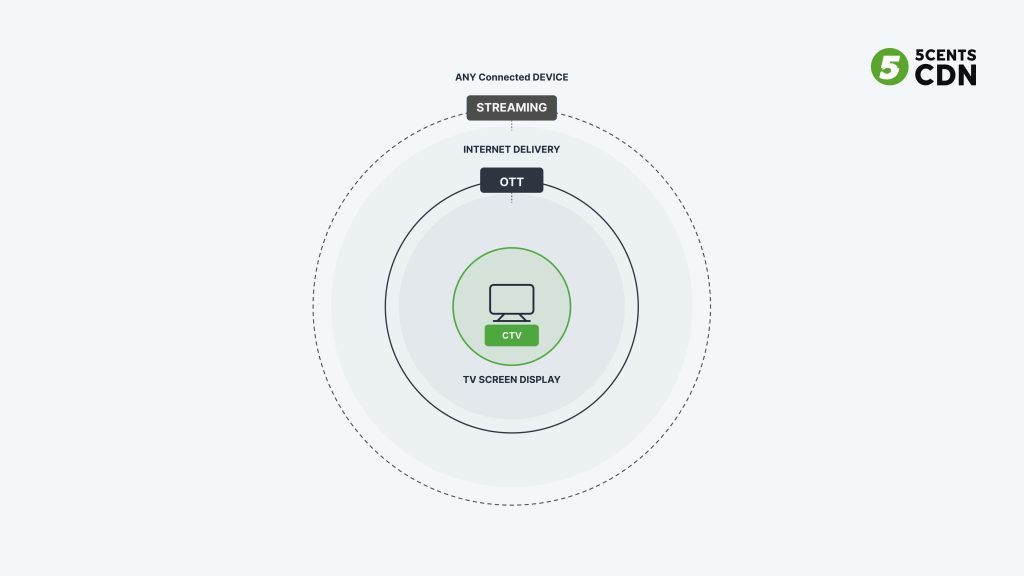
The living room screen has undergone a quiet revolution. What once required a cable subscription and a fixed schedule now responds to voice commands, remembers preferences, and delivers content the moment curiosity strikes. Connected TV sits at the center of this shift, blending the big-screen experience viewers still crave with the on-demand flexibility they now expect. For marketers, the same technology opens precise pathways into households that traditional television could never match. Understanding CTV is no longer optional for anyone who watches or anyone who hopes to reach those watchers.
The Screen That Thinks for Itself
Connected TV refers to any television set or device that streams video content over the internet rather than through traditional broadcast or cable signals. Smart TVs with built-in apps, streaming sticks, gaming consoles, and set-top boxes all qualify. The defining trait is the network connection that turns a passive display into an interactive platform.
Viewers notice the difference immediately. Instead of flipping through channels, they open apps, search by title or actor, resume a series exactly where they left off, and receive recommendations shaped by past choices. The experience feels closer to using a tablet than watching linear television, yet it retains the shared, immersive quality of a large screen. Families gather around the same device, but each person can later continue individual viewing on their own terms. The technology removes the old friction of appointment viewing while preserving the social ritual of watching together.
This flexibility carries practical advantages. Travelers stream the same shows they left unfinished at home. Parents restrict content by profile. Sports fans access live events alongside on-demand highlights without juggling multiple subscriptions or devices. The television becomes less a receiver of signals and more a personal media hub that adapts to the household’s rhythms.
Precision Meets Scale for Brands
Marketers encounter an entirely different set of possibilities. Traditional television advertising bought broad reach with limited control. Connected TV advertising buys audiences. Advertisers can target by demographics, interests, viewing behavior, household characteristics, and even contextual signals such as the type of content currently playing. A campaign promoting outdoor gear can appear during nature documentaries while a financial services message surfaces during business news, all without relying on crude daypart assumptions.
The measurement advantage is equally significant. Unlike the estimated ratings of linear TV, CTV campaigns often deliver clearer signals about whether an ad was completed, whether a viewer took a subsequent action, and how different creative versions performed. Attribution models can connect exposure on the big screen to website visits, app downloads, or in-store traffic with greater confidence than was previously possible. This closes a long-standing gap between television’s emotional power and digital’s accountability.
Yet the opportunity comes with new responsibilities. Viewers who enjoy seamless streaming grow sensitive to interruptions that feel irrelevant or excessive. Frequency management becomes critical; the same household should not see the same commercial repeatedly across multiple apps. Brand safety tools must filter environments carefully so that premium messages do not appear alongside unsuitable content. The most effective CTV strategies treat the living room with the same respect digital marketers learned to apply to social feeds and search results.
How Viewing Habits Quietly Reorganize
The rise of connected television has altered more than technology. It has reshaped the rhythm of daily media consumption. Appointment viewing has not disappeared, but it now coexists with pure on-demand choice. Live sports, awards shows, and certain reality competitions still draw simultaneous audiences, yet even those events are often watched with second-screen accompaniment or later revisited in condensed form.
Households increasingly maintain multiple streaming subscriptions and move fluidly among them. The concept of “what’s on” has been replaced by “what do we feel like.” Discovery tools, personalized home screens, and algorithmic suggestions now influence which titles gain cultural momentum. A series that might once have needed network promotion can build an audience through organic sharing and platform recommendations.
For marketers this fragmentation creates both challenge and opportunity. Reach requires presence across multiple platforms rather than a single network buy. At the same time, the ability to follow an audience across environments allows more coherent storytelling. A brand can introduce a message on one service, reinforce it on another, and measure the cumulative effect with greater precision than linear schedules ever allowed.
Trust as the Decisive Currency
As targeting grows more sophisticated, the relationship between viewers and advertisers depends increasingly on perceived fairness. People accept relevant advertising when it feels useful or at least non-intrusive. They resist it when it appears to know too much or appears too often. Connected TV platforms that offer transparent controls, clear opt-out mechanisms, and thoughtful ad experiences tend to retain goodwill. Those that push frequency or relevance past comfort levels risk the same backlash once directed at overly aggressive digital advertising.
Marketers who succeed in this environment treat data as a tool for relevance rather than surveillance. They test creative that respects the large-screen context—shorter formats for some placements, richer storytelling for others—and they monitor viewer response signals carefully. The brands that earn sustained attention are those that understand the living room remains a shared, semi-private space even when the content arrives through the internet.
The Expanding Horizon of Living-Room Influence
Connected TV continues to evolve as new devices, interfaces, and content models emerge. Voice navigation, multi-view options, and deeper integration with other household systems will further blur the line between television and broader entertainment ecosystems. Viewers will expect even greater personalization and control. Marketers will gain additional signals and formats, provided they remain attentive to the human experience on the other side of the screen.
The core definition remains straightforward: Connected TV is television delivered through an internet connection and experienced on a large screen. Its implications run deeper. For viewers it restores choice and convenience without sacrificing the communal power of the big display. For marketers it restores accountability and precision without abandoning the emotional resonance that has always made television distinctive. Those who grasp both sides of the equation will shape the next chapter of screen-based storytelling and commerce


