
Marketing agencies live and die by their ability to deliver consistently at scale. A single account manager handling five clients, a creative team producing content across twelve campaigns simultaneously, a media buyer optimizing spend across multiple platforms — none of this works without documented processes that don’t depend on any single person’s memory. Templates are the infrastructure that makes agency work repeatable, trainable, and defensible when clients ask how their campaigns are being managed.
Purpose-built marketing agency project management templates go beyond simple task lists. They cover campaign planning, creative briefs, content calendars, performance reporting, client communication logs, and budget tracking — all structured around how agency work actually flows, not how generic project management tools assume it works.
The Documents Every Agency Needs Standardized
Most agency inefficiency comes from reinventing the same documents on every new account. A creative brief written from scratch for every campaign introduces inconsistency in what information gets captured and how it gets communicated to the creative team. A monthly performance report built in a new format for each client takes twice as long to produce and is harder to compare across periods. Standardization doesn’t reduce creativity — it removes the friction from the process so creative energy can be directed at the work itself, not the paperwork around it.
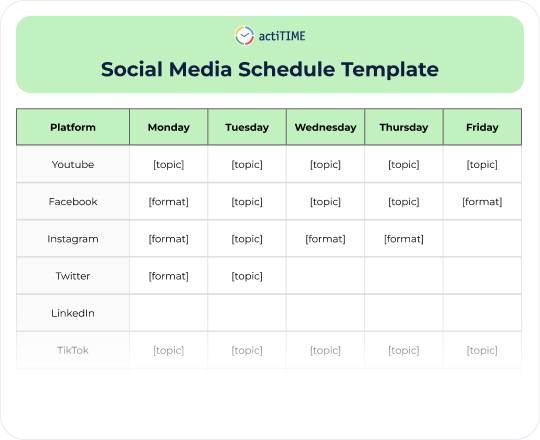
Core templates every agency should standardize: campaign brief, content calendar, social media publishing schedule, monthly performance report, client meeting notes, and campaign budget tracker. A social media schedule template that covers platform, content type, publish date, copy, and approval status turns a chaotic content calendar into a managed workflow that any team member can maintain and hand off.
Scaling Template Use Across the Agency
Templates only create value if they’re actually used consistently. The most common failure mode is a template library that exists but isn’t enforced — different account managers use different versions, client-facing documents look different from account to account, and the “standard” process exists only in name. Implementation requires: a central template repository with version control, clear guidance on when each template applies, and a review process that catches non-standard documents before they reach clients. Once the habit is established, the consistency benefits compound over time as the team builds institutional knowledge in a shared format.


