
Developers are often the most resistant group when a company rolls out time tracking. The concern is reasonable — logging every hour feels like surveillance, and context-switching between a coding task and a time entry breaks flow. But when it’s done right, time tracking for engineering teams serves a completely different purpose: it produces the data needed to estimate future projects accurately, justify headcount, and protect developers from scope creep that was never accounted for in the original plan.
The key is choosing time tracking for developers that fits how engineers actually work — with timer start/stop, integrations with dev tools, task-level granularity, and minimal administrative overhead between the actual work and the log entry.
What Good Developer Time Tracking Looks Like
The best implementations share a few characteristics:
- Task-level, not project-level: Logging 6 hours to “Backend Development” tells you nothing. Logging 2 hours to “Auth refactor,” 1.5 hours to “API endpoint review,” and 2.5 hours to “Bug fixes — payment flow” gives you data you can act on.
- Jira/GitHub integration: If developers are already updating tickets, time tracking that reads from those systems adds almost no friction.
- No approval bottlenecks: Developers should be able to log, edit, and submit time without waiting for manager approval on routine entries.
- Reporting that serves engineers: Show developers how their time breaks down by project type — feature work vs. maintenance vs. meetings. This data helps them advocate for more focused work time.
Using the Data to Improve Estimates
The most valuable output of consistent time tracking isn’t the invoice — it’s the estimation database. When you have 12 months of actual hours on feature development by type and complexity, your next sprint planning session starts from evidence rather than gut feel. Sprints become more predictable, developers experience fewer end-of-sprint crunches, and product managers stop padding estimates by 30% as a buffer against unknown unknowns. That benefit alone justifies the tool.
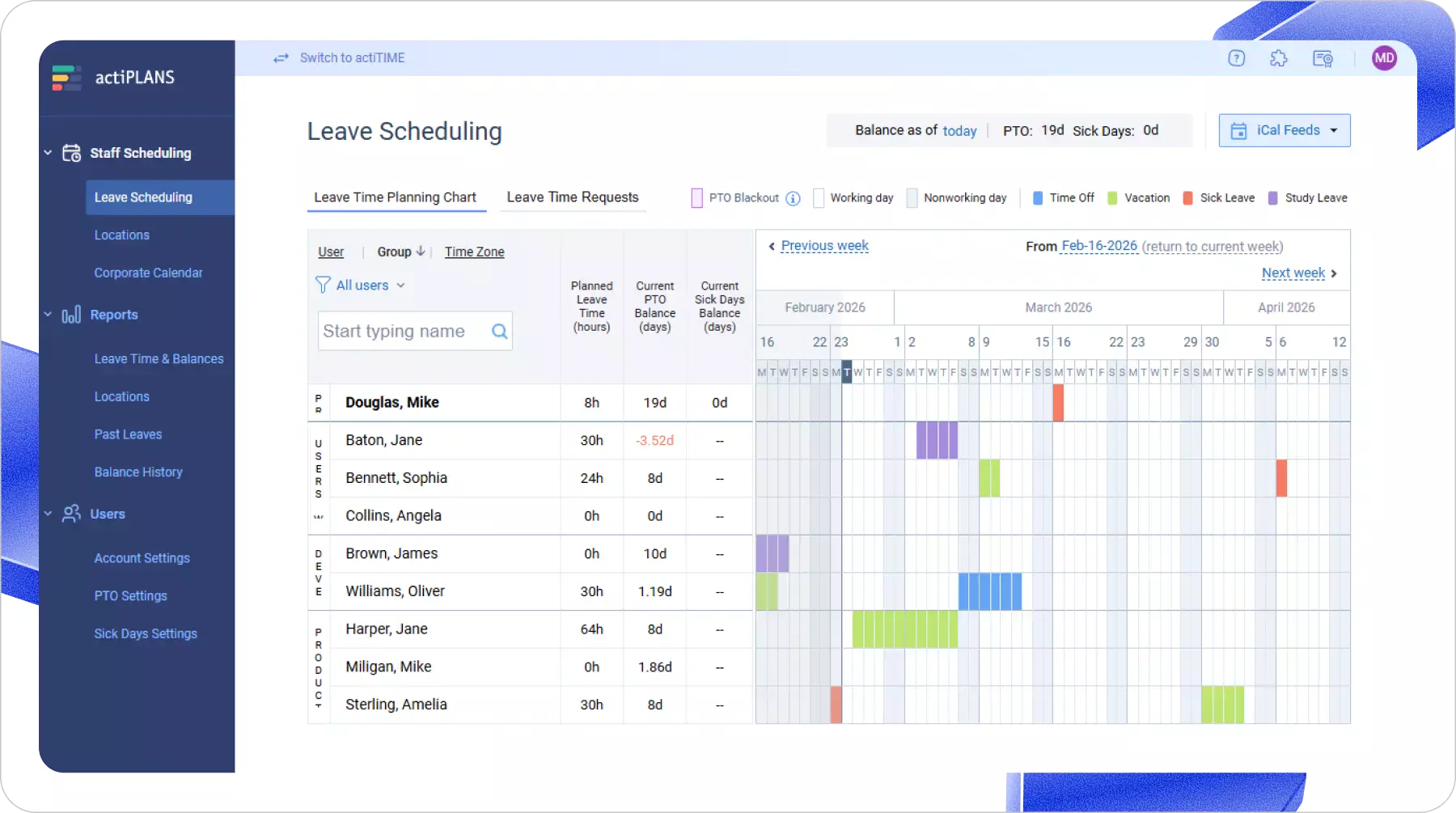
For teams that also need to plan leave and capacity alongside development cycles, actiPLANS integrates absence management with time tracking so sprint capacity reflects who is actually available — not who is theoretically scheduled.


